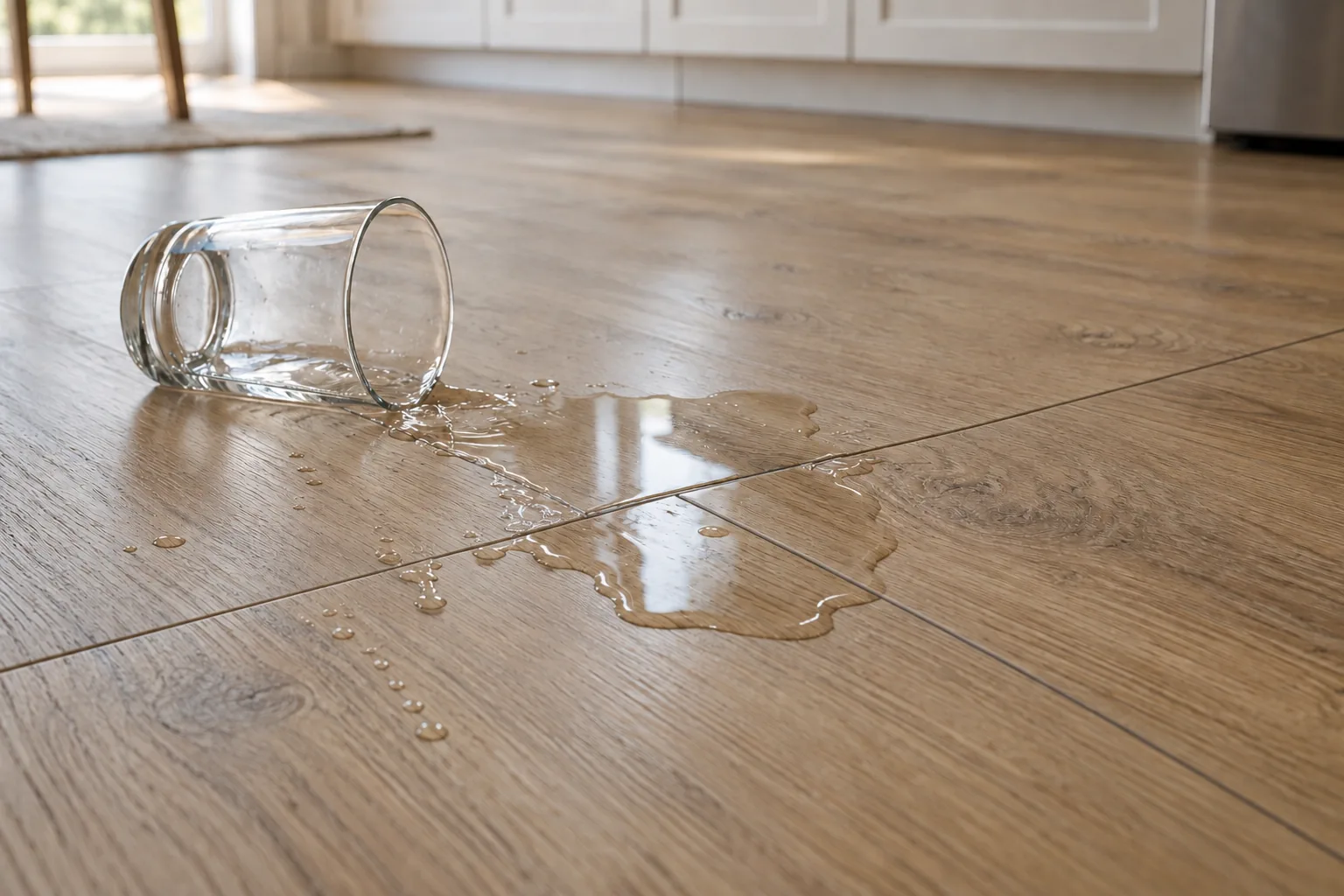
A glass tips over in a kitchen. Your SPC planks may cope perfectly well with the spill. But has the water stayed above the floor, or found a route through a joint or around the perimeter? When you specify waterproof SPC flooring for your collection, those are separate questions.
The word “waterproof” needs a clear scope. It can describe the flooring material, the performance of an assembled joint, or a defined warranty against water damage. Before putting it on your packaging, establish which promise your product can support.
What does waterproof SPC flooring actually mean?
Start by separating three parts of the specification:
| What you are checking | The question to ask |
|---|---|
| The plank | What happens to the product itself when exposed to water under the stated conditions? |
| The assembled joints | Can water pass through the connections between correctly installed planks? |
| The finished installation | What details and limitations apply around walls, doorways and other interruptions? |
A demonstration on the middle of one board does not answer the second question. A successful joint test does not, by itself, answer the third.
That distinction gives you a better way to compare products. Two collections can both carry a waterproof description while offering different installation requirements and warranty coverage.
Your click system needs its own evidence
Watertight joints are an engineered feature that should be verified for the actual product.
For example, Välinge’s 2G PRO technical sheet describes combining its locking system with Dry technology to achieve watertight joints. This is the technology owner’s product claim, rather than an independent test report for your collection.
The useful point is the distinction within the specification: naming a click system and confirming its water-sealing configuration are separate steps. You should not assume that every product using the same broad locking-system family has identical water performance.
Ask your supplier to identify the exact configuration and provide the supporting results for the flooring you intend to order. A brochure for a technology is useful background; a report tied to your product is more useful when approving your own claims.
A watertight joint does not settle the whole installation
The edge of the room deserves attention too.
Quick-Step’s Alpha Vinyl Pad Herringbone installation guide, version May 2025, gives specific instructions for sealing the perimeter and obstacles in areas exposed to spills. It also excludes applications such as shower enclosures, pool areas and rooms with built-in drainage.
Those instructions apply to that named product. They illustrate why you need an installation document that matches your own collection, including its permitted applications and finishing details.
Do not treat a waterproof flooring description as permission to use the product in any wet room. Likewise, do not improvise a sealing method or fill expansion spaces with an arbitrary material. Obtain the specified detail for that floor.
Read what the water warranty actually covers
A warranty can protect the flooring against particular water-related problems without covering every consequence of a leak.
Quick-Step’s vinyl warranty, version October 2026, sets conditions for perimeter sealing and maintenance on products with water-resistance coverage. It also lists exclusions for water damage from sources including leaking appliances and pipes. These are the terms for the specified Quick-Step products, not conditions that automatically apply to other brands.
For your collection, review the permitted exposure, installation obligations, exclusions and remedy together. Check whether the cover concerns replacement planks alone or also addresses labour and damage beneath the floor. A large waterproof icon cannot communicate all of that.
What to confirm before approving your collection
We recommend making the evidence review specific enough that your supplier can answer it in writing:
- Identify the product. Record its construction, dimensions, locking configuration and any sealing treatment. Confirm that the report relates to that specification.
- Define the test. Ask for the method, exposure duration, sample arrangement and acceptance criteria. Establish whether it measured changes to the plank, leakage through joints, or both.
- Check the scope of the assembly. Confirm which joints and junctions were included and whether any special preparation was required.
- Align the documents. Your packaging, product page, installation guide and warranty should describe the same level of protection.
- Keep shipment checks in their proper role. Inspection can help check the agreed product and visible condition; it should not be presented as a substitute for performance testing. See how our product-specific PSI works.
For a private-label collection, the deliverable should be a traceable specification with matching evidence and clear instructions. That gives you a defensible answer when someone asks what “waterproof” means for your flooring.